Author: Tzu Hsin Lin
-
Written Component – Position through contextualising
References:
- Banner, F. (1997) The Nam [Artist’s book].
- Frampton, H. (1970) Zorns Lemma [Film]. USA.
- Niu, Jun Qiang (2020) Reveal [Video installation].
- Palmer, Ollie (2016) 24fps Psycho [Video / digital work].
- Marker, C. (1983) Sans Soleil [Film]. France.
- Hito Steyerl (2013) How Not to be Seen. A Fucking Didactic Educational .MOV File [Video / digital work]
- Gordon, D. (1993) 24 Hour Psycho [Video installation]. London: Hayward Gallery. Text:
- Barthes, R. (1977) ‘Rhetoric of the Image’, in Image Music Text. London: Fontana Press, pp. 32–51.
- Drucker, J. (2020) ‘Introduction’ and ‘Semiotics, Materiality, and Typographic Practice’, in The Visible Word: Experimental Typography and Modern Art, 1909–1923.
- Lust, M. et al. (eds.) (2020) Conditional Design Workbook. Amsterdam: Valiz.
- Flusser, V. (1983) ‘The Apparatus’, in Towards a Philosophy of Photography. London: Reaktion Books.
- Steyerl, H. (2012) ‘In Defense of the Poor Image’, in The Wretched of the Screen. Berlin: Sternberg Press, pp. 31–45.
-
Position through Contextualising -1
This map shows the relationship of text and image between the references and my project.
Reference:
Banner, F. (1997) The Nam [Artist’s book].
https://www.fionabanner.com/works/thenamfadein/index.htm
Frampton, H. (1970) Zorns Lemma [Film]. USA.
https://youtu.be/9LpEimeC9ek?si=_Yb5Nag1p0_UQpPJ
Niu, Jun Qiang (2020) Reveal [Video installation].
https://natniu.net/w/19.html
Palmer, Ollie (2016) 24fps Psycho [Video / digital work].
https://vimeo.com/166328006?fl=pl&fe=sh
Marker, C. (1983) Sans Soleil [Film]. France.
https://kino.kompot.si/w/13w2fFHNC9XJMr5kAHV559 -
Written Response V contextualising
Group D
This project investigates how visual structure shapes the meaning of time within data visualisation. Beginning with historical research into different representations of time — from cyclical calendars to linear industrial charts and geological timelines — we observed that form does not merely organise information but constructs distinct temporal logics. Circular systems embed time within ecological cycles, linear grids frame time as measurable progress, and layered diagrams decentre human agency within deep time.
From this observation, we developed a critical question: if a dataset remains constant, how does visual structure reshape temporal meaning?
Using a single commuting emissions dataset, we designed a method to isolate the effect of form. We first developed parallel visual interpretations while keeping the data fixed. Each version was analysed through four shared criteria: aesthetic intensity, readability, metaphor, and knowledge production. We then rewrote one another’s designs under the same conditions to further test how structural shifts alter perception.
Through comparison, we found that identical data can be reframed as accumulation, compression, or collective distribution. Temporal meaning was not embedded in the dataset itself but constructed through hierarchy, orientation, and scale.
This project positions data visualisation not as neutral display, but as an active agent in shaping how urgency, responsibility, and environmental time are understood.
Individual
-
Methods of Contextualising (further development)
Further Individual Development (after final presentation)
-
Methods of iterating III
How to use these methods to generate a design?
To answer this question, I start with a critical aspect: When reading is completely given to conditions and data, How will the text gradually lose its established reading system? Therefore, I tried to develop a rigorous process.
Step 1 — Decide how the text should be read
(not how it should look)
Step 2 — Set rules instead of fixing the layout
(what can appear, disappear, or fail)
Step 3 — Let conditions produce the result
(no correction after)
Normally, design focuses on adjusting layout until the text becomes readable. In this project, I stop adjusting the layout and move all design decisions to the rule-setting stage. Once the rules are defined, background data controls position, scale, and visibility. Reading is no longer guaranteed—it becomes a conditional outcome.
The reason that I need to define how to read first is because if I don’t define how the text is meant to be read first, the conditions can’t be evaluated.
Subject (baseline)
I chose Conditional Design Manifesto as my starting point. The text which is retrieved from online is regarded as a neutral linguistic material, not the content itself.
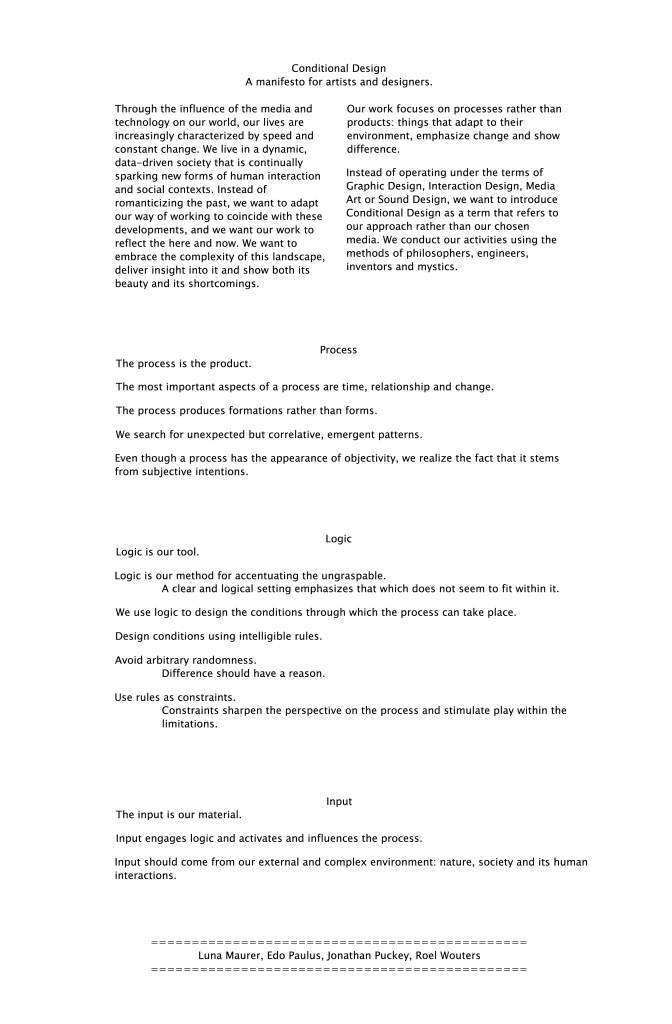
Luna Maurer, Edo Paulus, Jonathan Puckey and
Roel Wouters, ‘Conditional Design Manifesto’,
Conditional Design Workbook, 2013
Data resource (site)
I chose this wooden surface as the base (background data) because I needed a physical site to ground the poster in reality.
The wood grain provides a wide range of background variations, allowing more possibilities when mapping parameters to the design.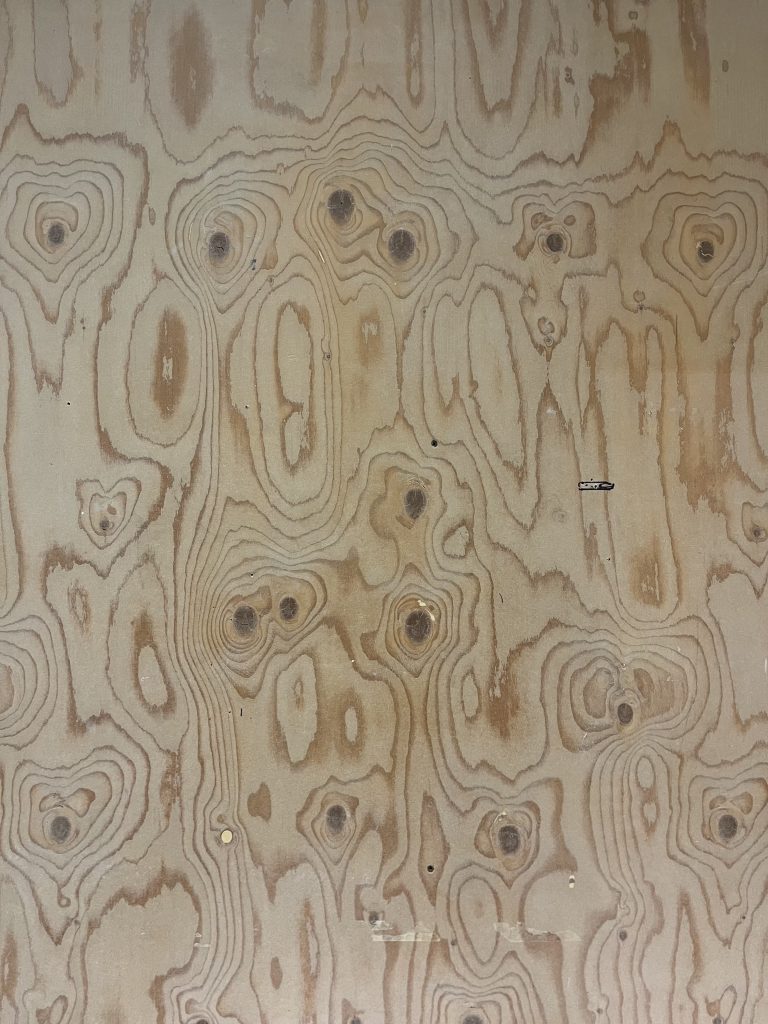
A wooden wall outside of K201.
Final outcomes
Iteration1 : Declarative Reading
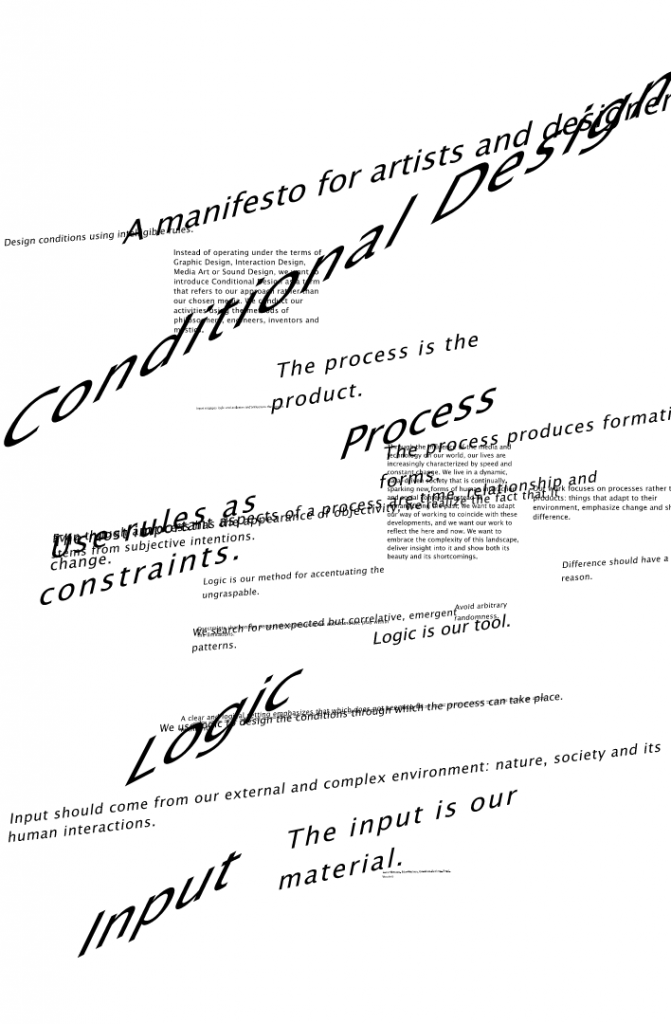
Conditions: skew, font size, character spacing
Iteration2 : Non-linguistic Reading
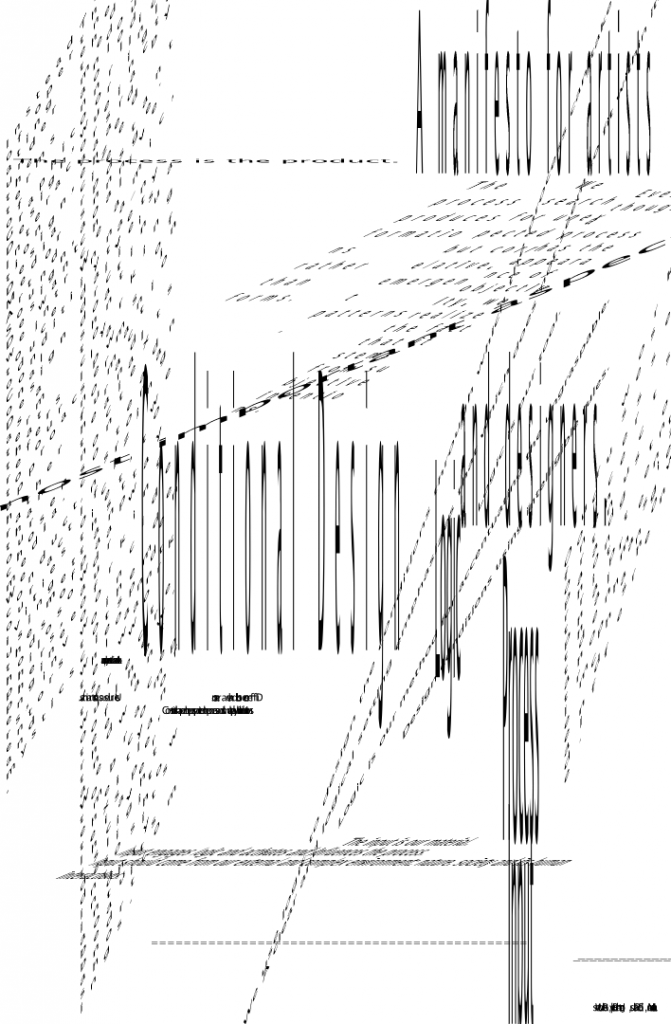
Conditions: skew, scale X, scale Y, character spacing
Iteration3 : Non-hierarchical Reading
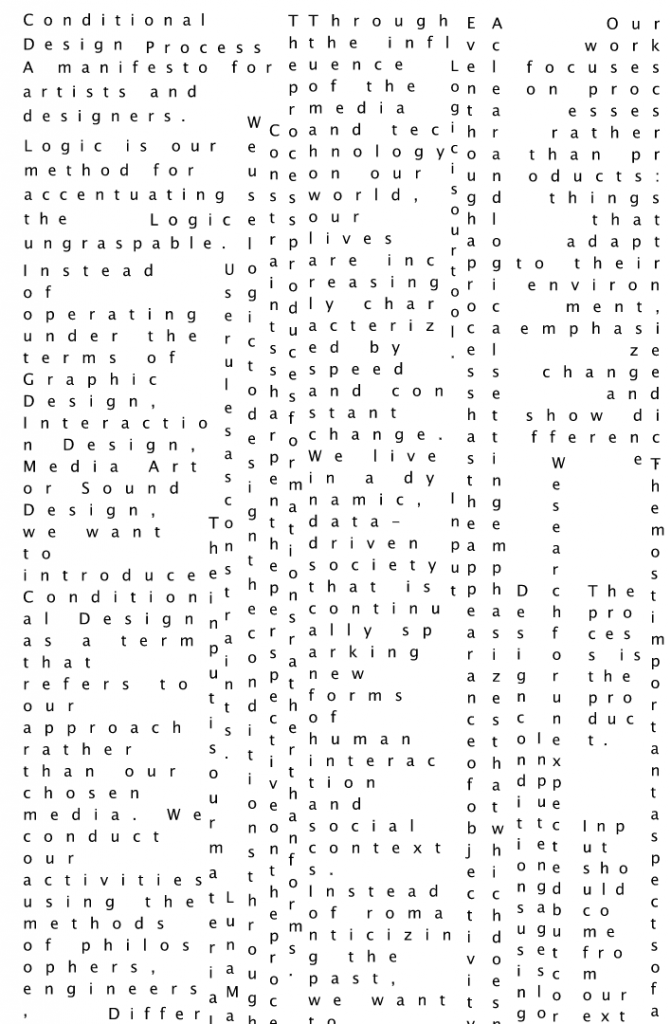
Conditions: Line spacing, Text box size, Font size, Character spacing
Iteration 4 : Indexical Reading
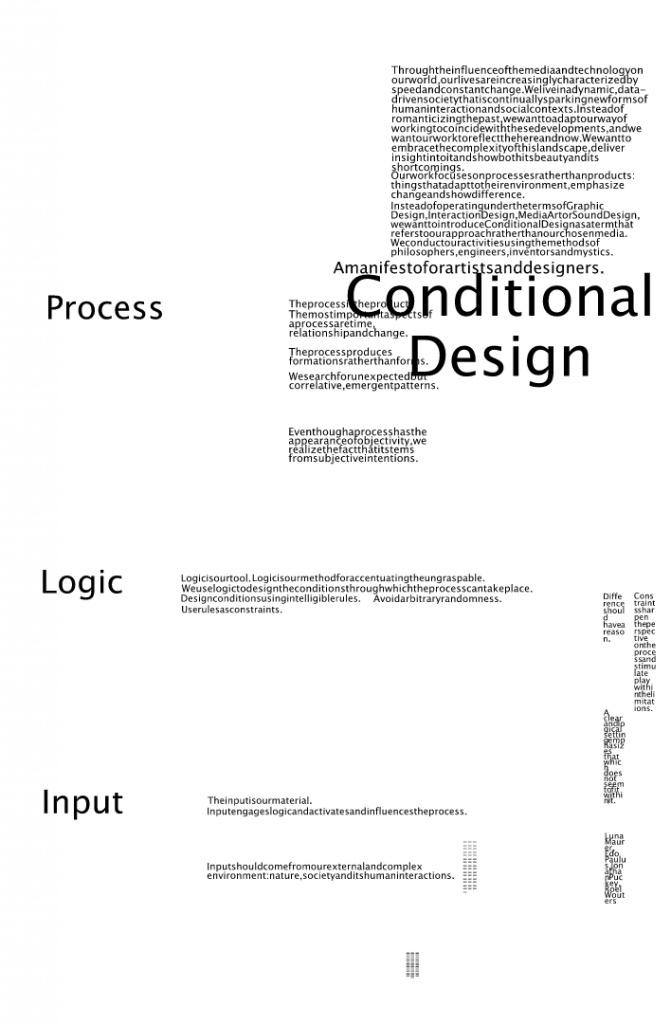
Conditions: Line spacing, Text box size, Font size, Word spacing, character spacing
Transformation process
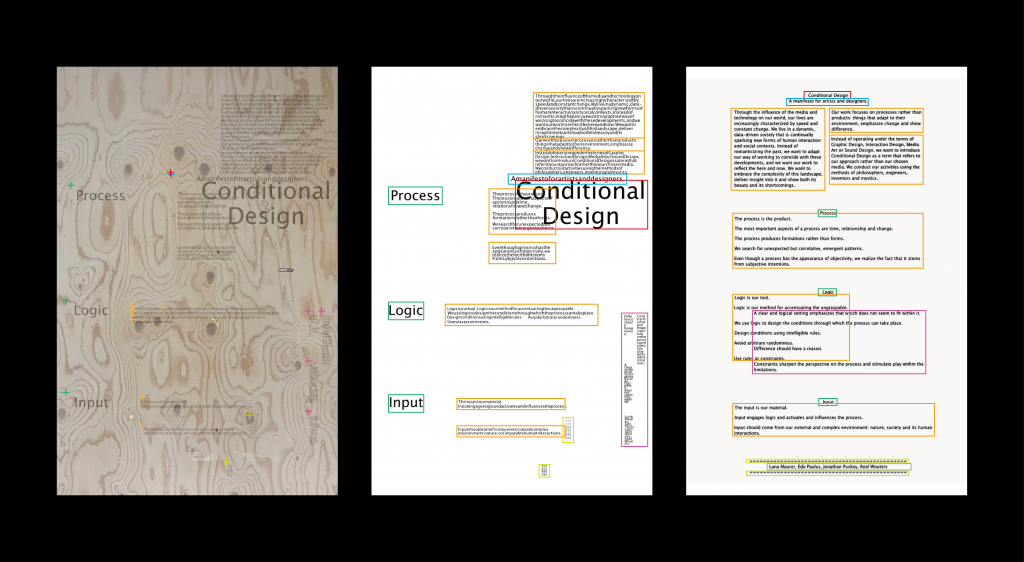
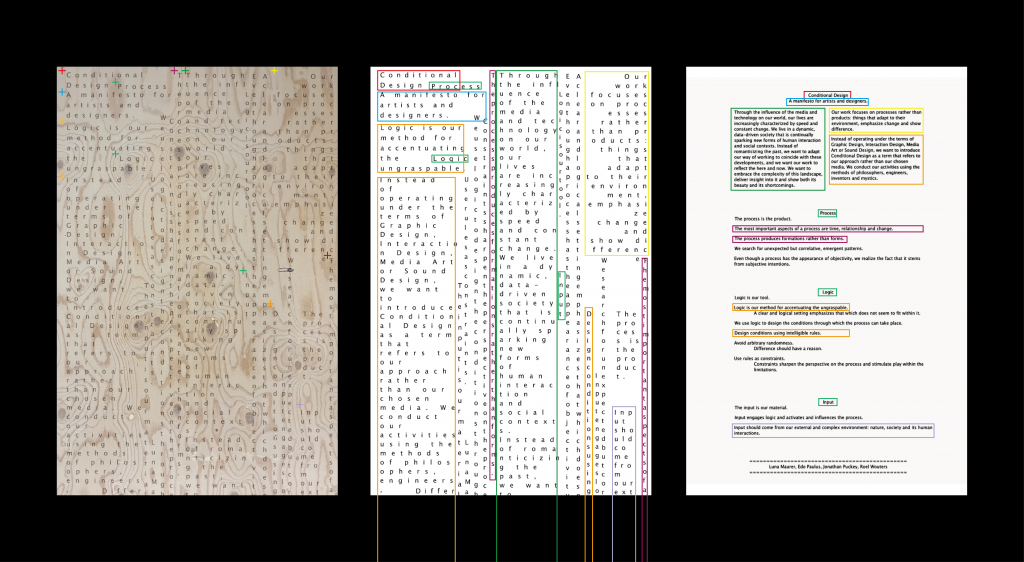
The image on the left shows how different text elements correspond to specific positions. The parameters of these positions are reflected in the applied conditions.
-
Methods of iterating II
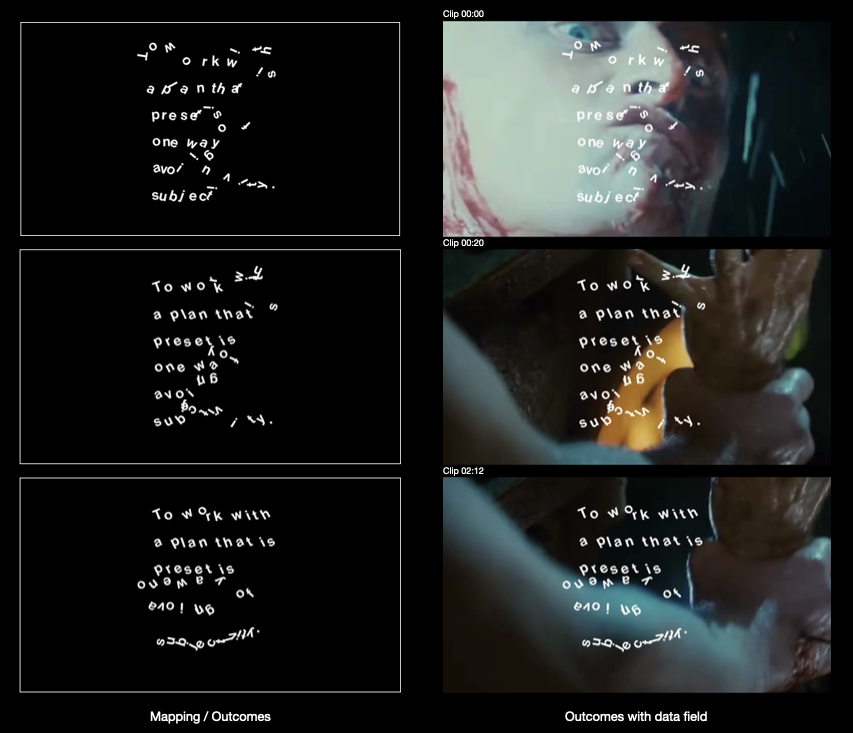
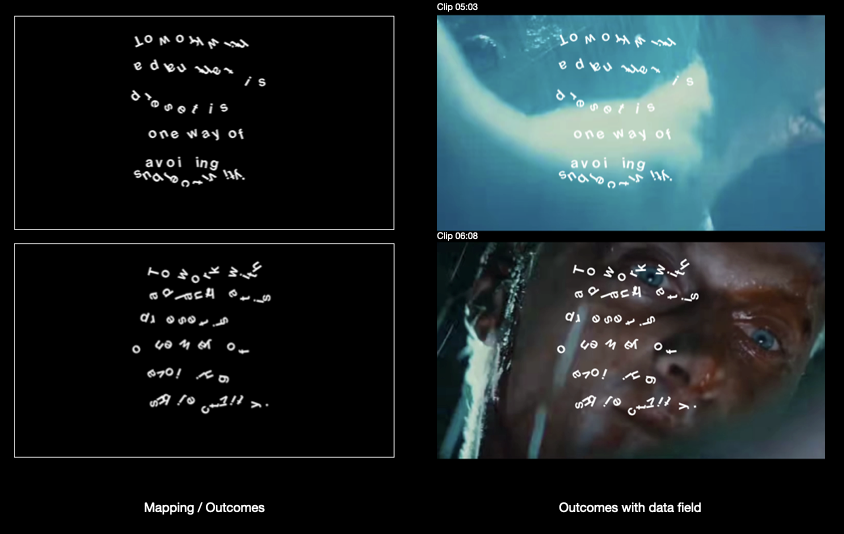
How to Hack
I reposition Cavalry from a tool for generating visual or motion effects into a system for setting and testing typographic conditions.
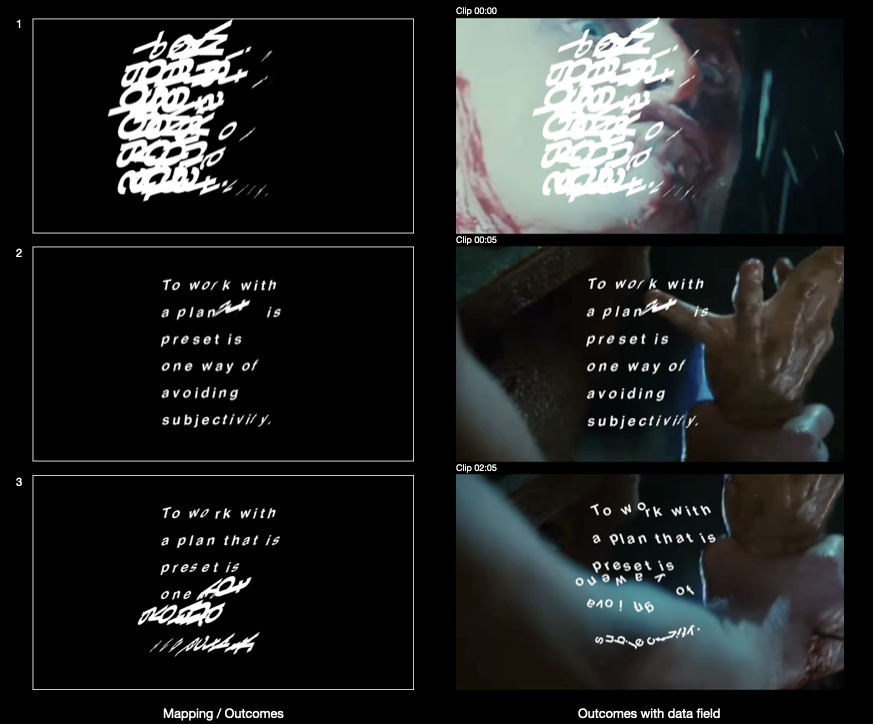
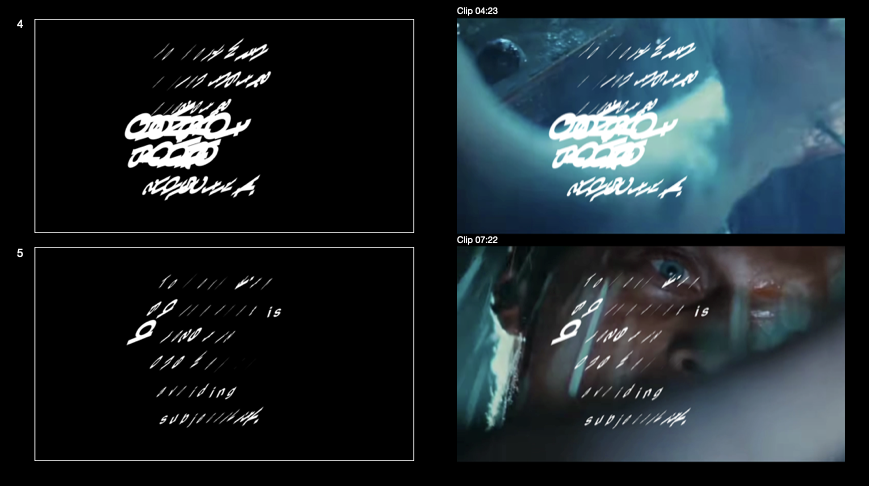
In this context, the image no longer functions as content, but as a source of conditions.
Data Source and Sampling Strategy
I choose a 5-second segment of film footage. and using it as a time-based data source. The narrative content is ignored; only numerical value changes are considered. In addition, sampling is taken at different time points within the clip.
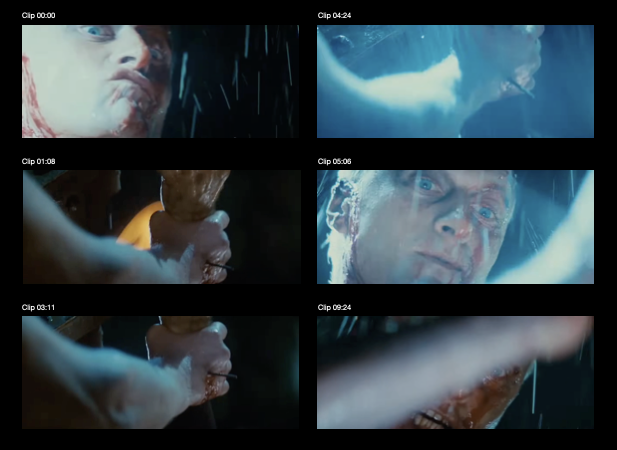
The structure of generating design
Layer 1: Baseline (unconditioned plane) (Control Variables)
Layer 2: isolation (Single-condition intervention, 5–6 pieces per group)
Layer 3: Compound (Condition stacking, 6-9 pieces per group)
Layer 1: Baseline
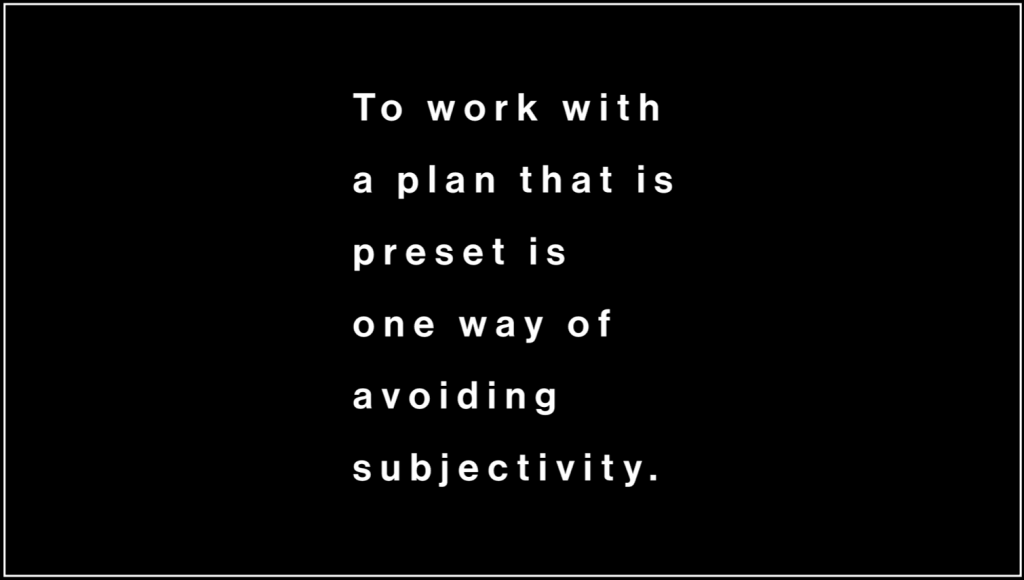
As a baseline for variations Rotation and Skew. 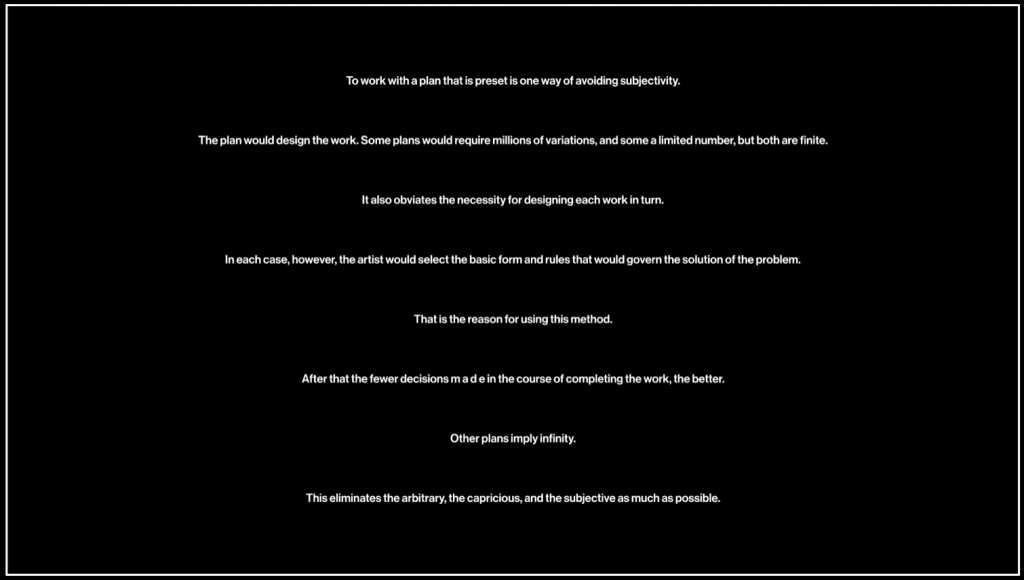
As a baseline for variations Character spacing. 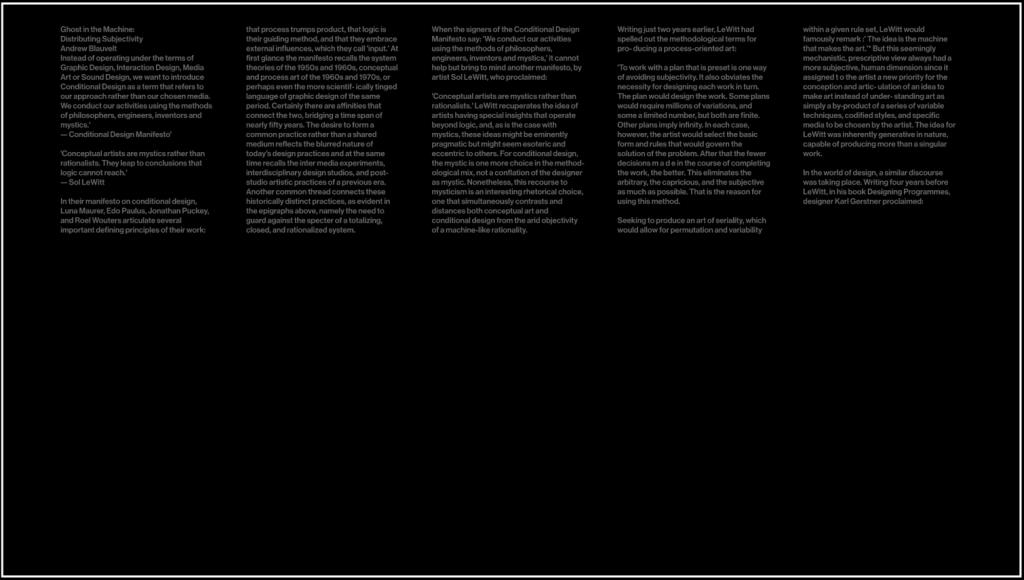
As a baseline for variations Text box size and Word spacing. These layouts align with three different variations.
Layer 2: isolation (Single-condition intervention, 5–6 pieces per group)
Rotation
Skew
Character spacing
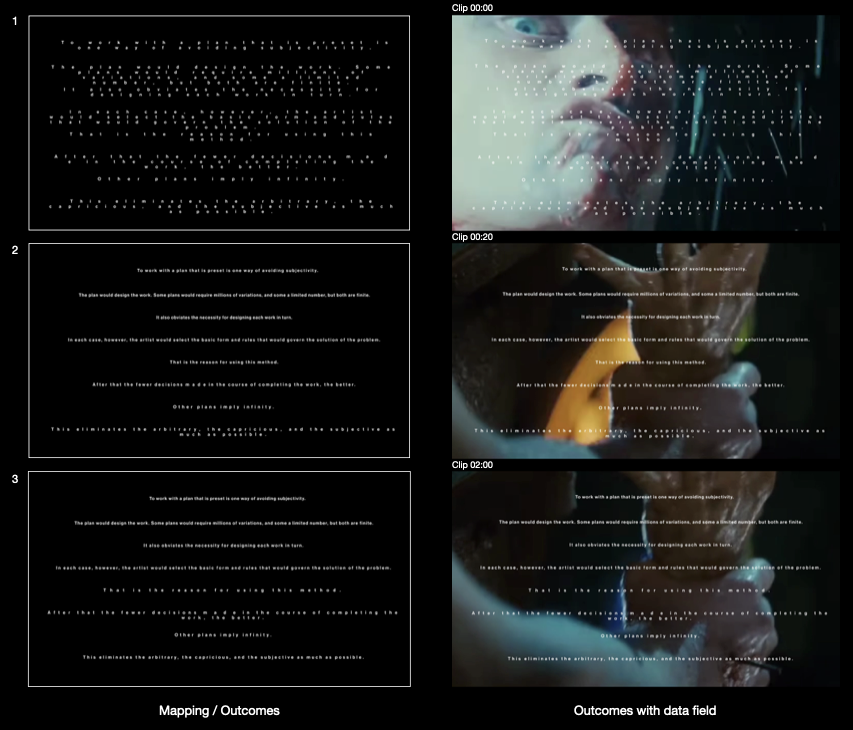
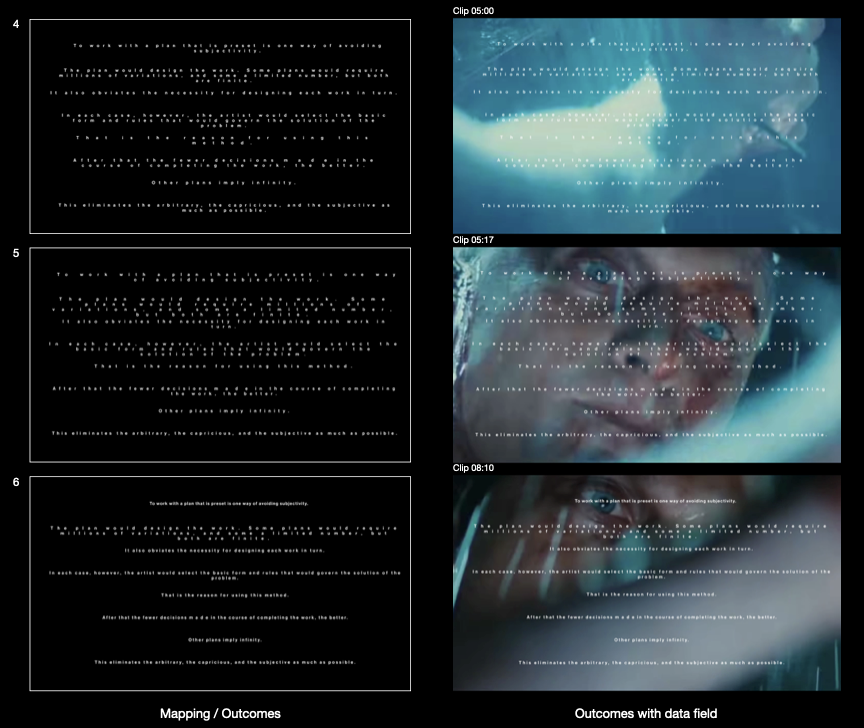
Text box size
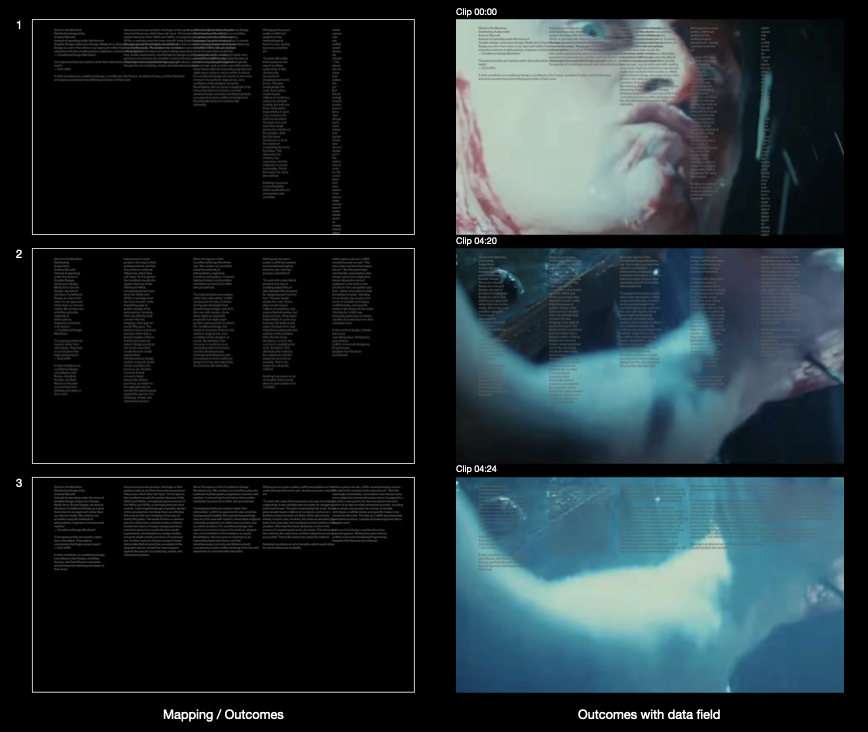
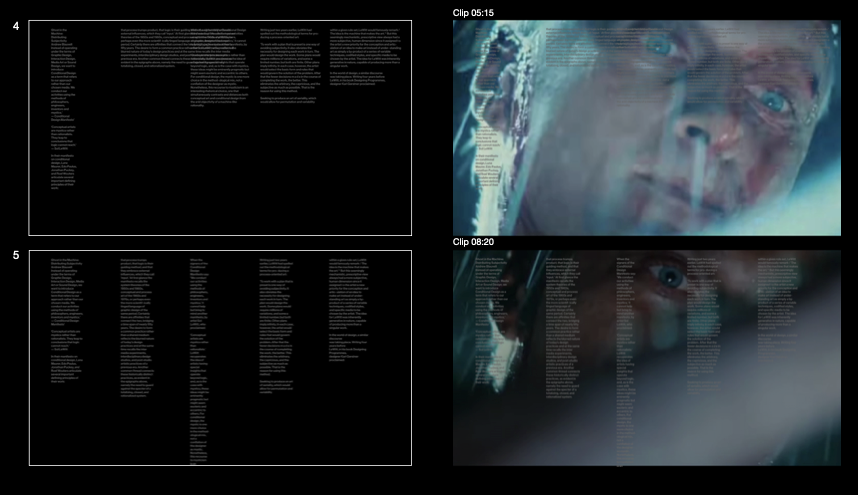
Word spacing
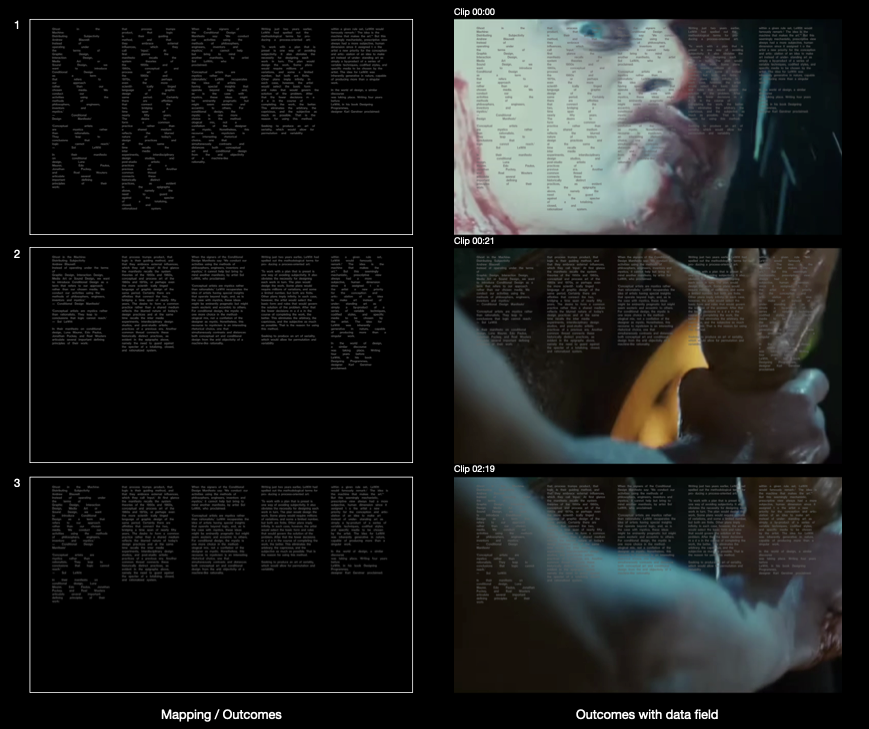
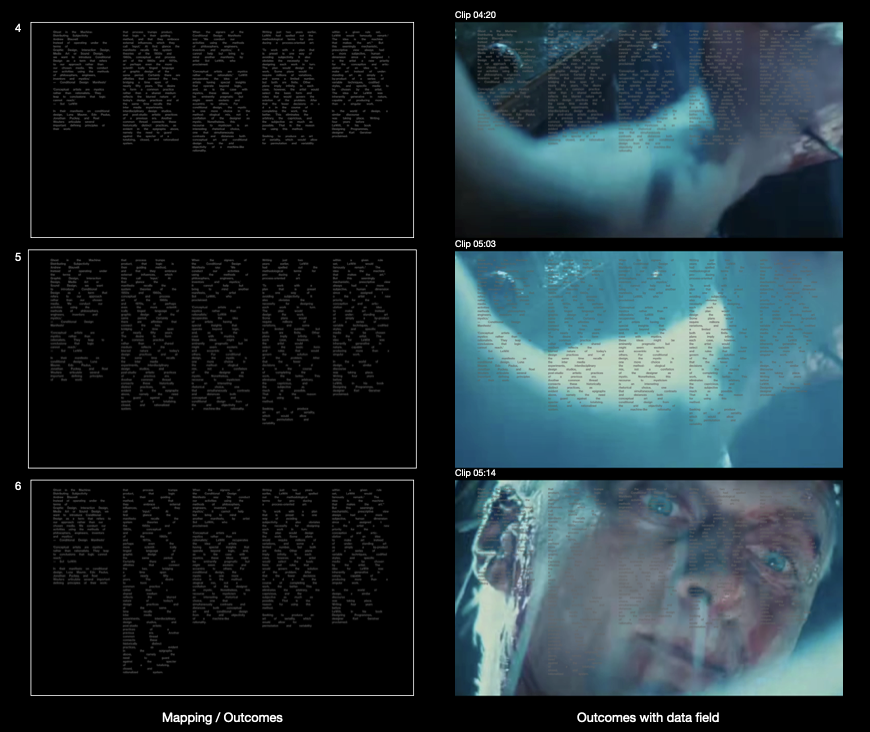
Layer 3: Compound (Condition stacking, 6-9 pieces per group)
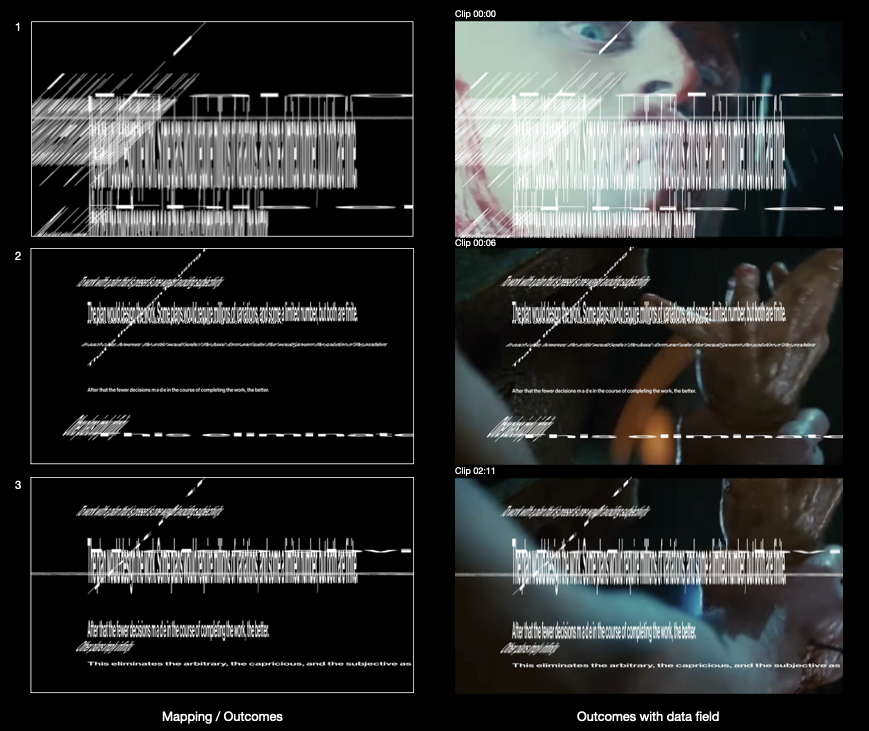
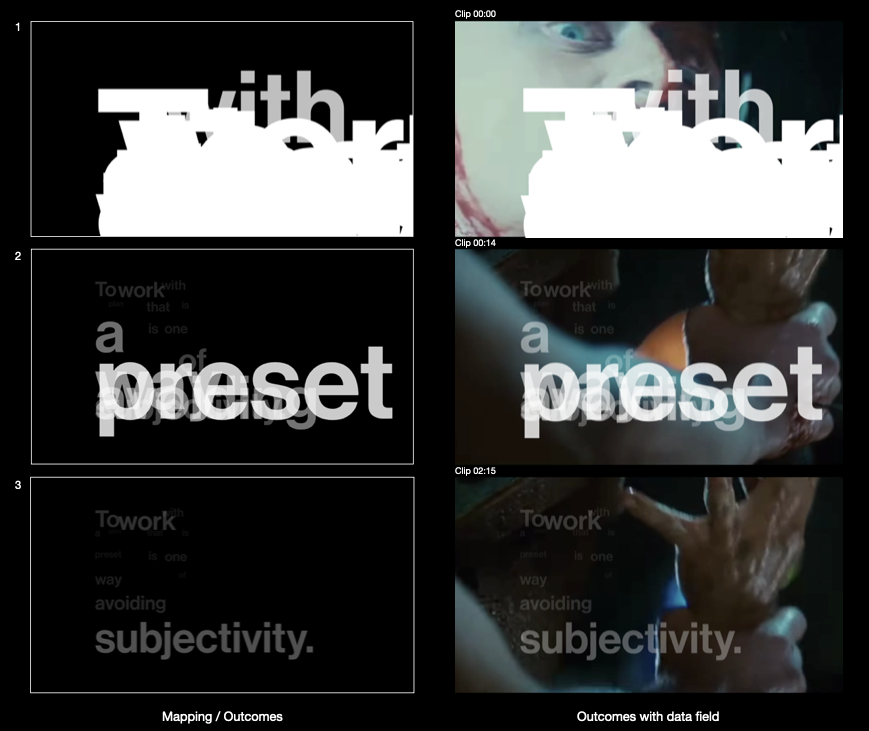
In this layer, I used multiple variations as conditions.
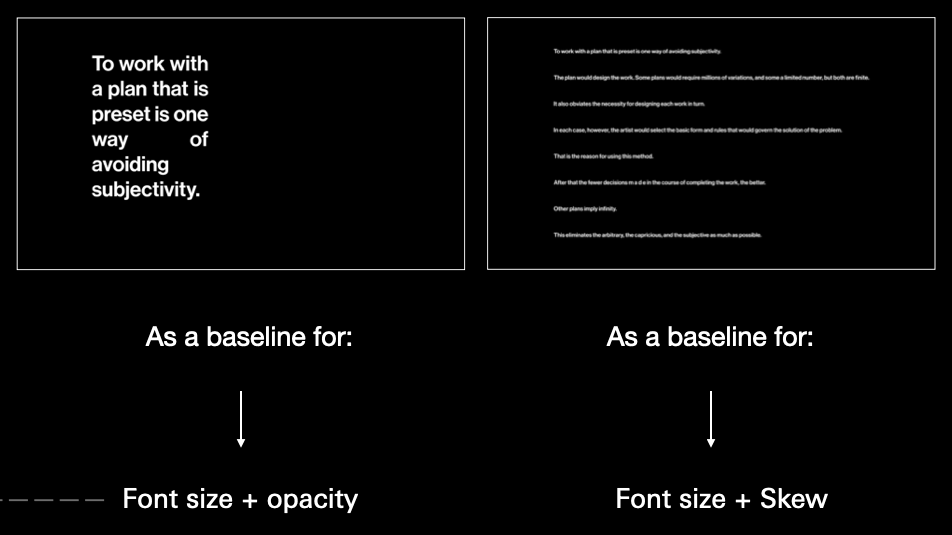
Font size + skew
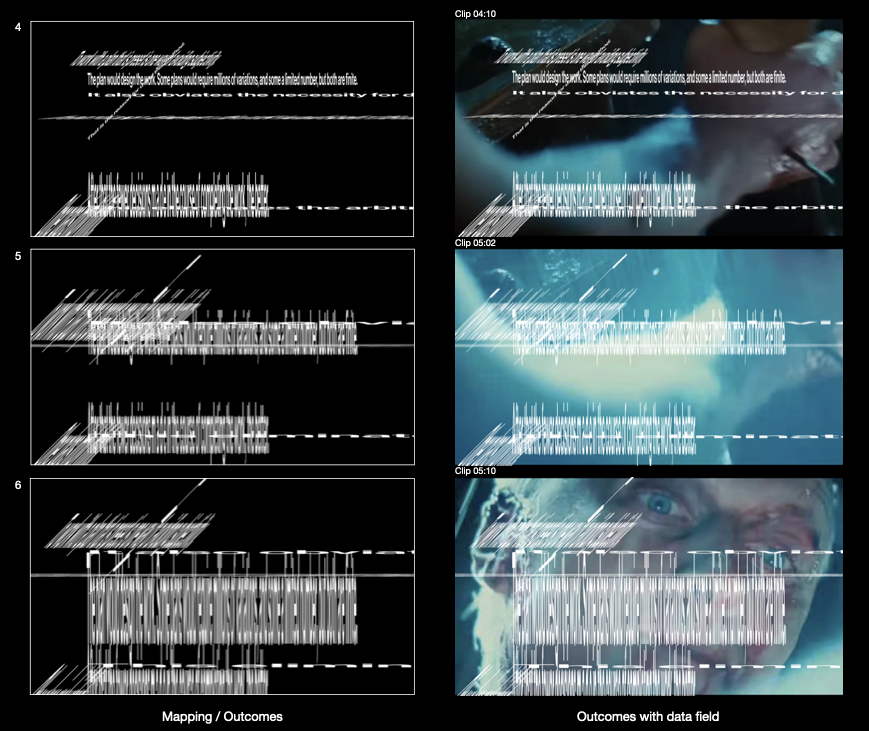
2. Font size + opacity
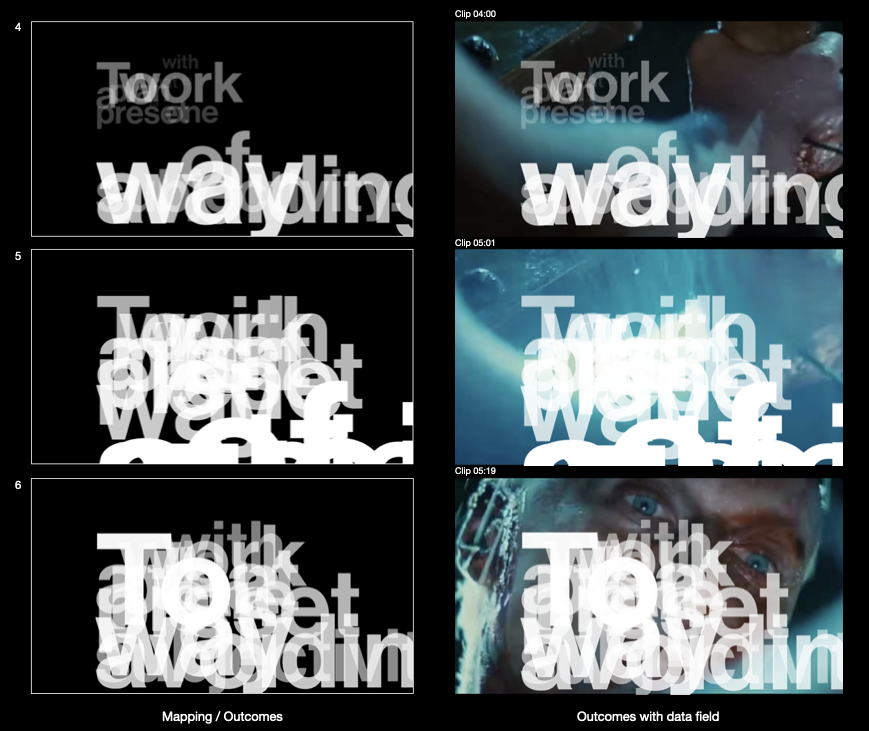
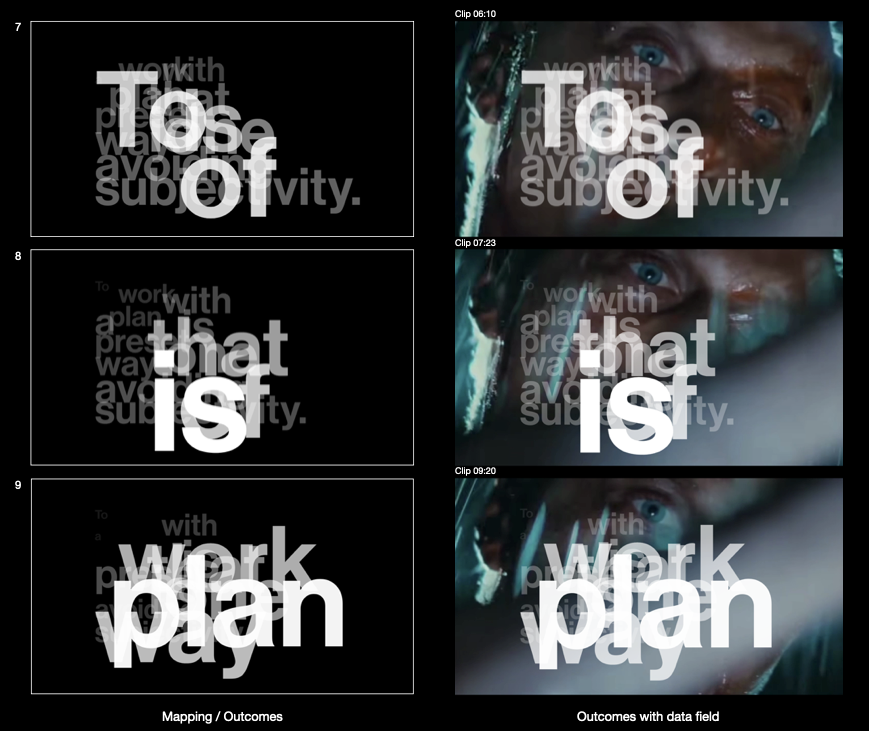
Knowledge Generated Through Iteration
1. I came to understand that the page itself is not neutral, but a conditioned structure.
2. What we usually perceive as a blank page is simply a condition that has been naturalized and hidden—a state in which parameters are present, but effectively set to zero.
3. When conditions can be explicitly set and adjusted, the role of the designer shifts from executing forms to defining and modulating conditions.