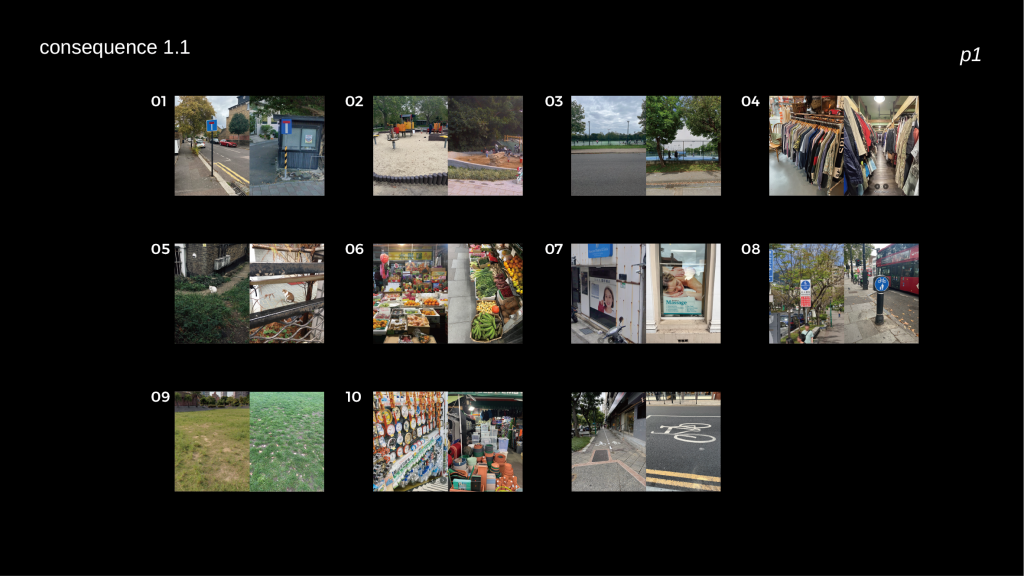
Category: Methods of Investigating

  • Methods of Investigating III

    The final outcome

    In this project, I realized that the choice of medium plays a crucial role. I considered several possibilities — such as creating a 3D interior model, a physical supermarket map, or a collage combining images and diagrams.
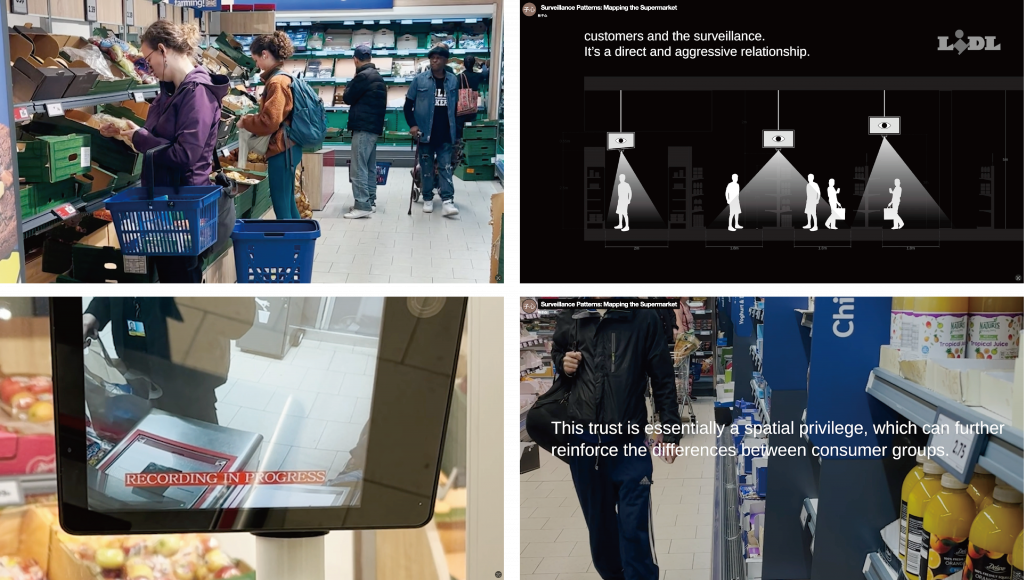
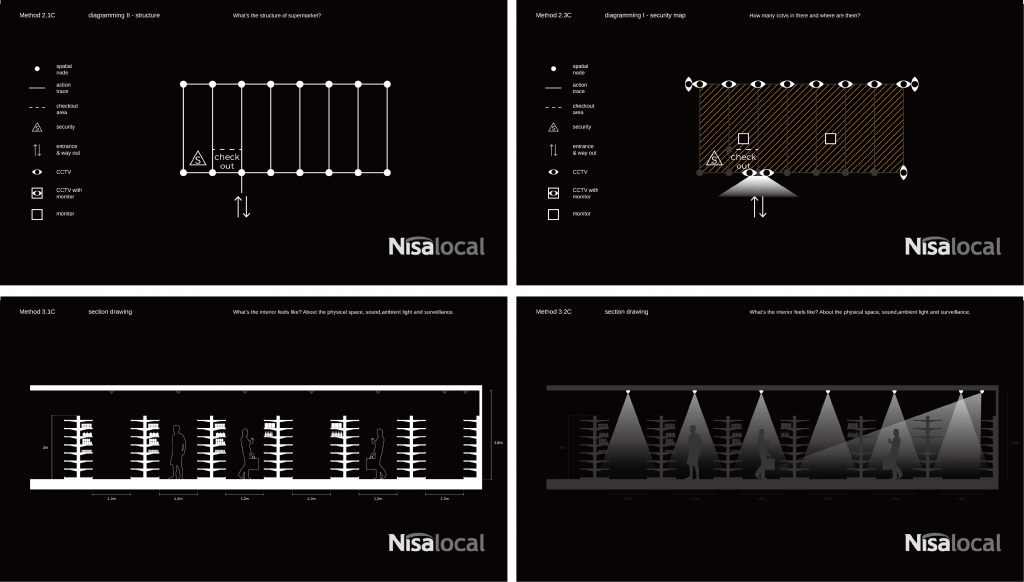
    The video stills of Surveillance Patterns: Mapping the Supermarket.

    However, these forms can only convey rational and logical ideas; they struggle to express the emotional experience of being watched by CCTVs. I believe both sides are equally important and should not be separated. For this reason, I chose video as my main medium. It allows me to combine image, text, and movement, and most importantly, to use sound — giving the project a richer sense of atmosphere and texture.
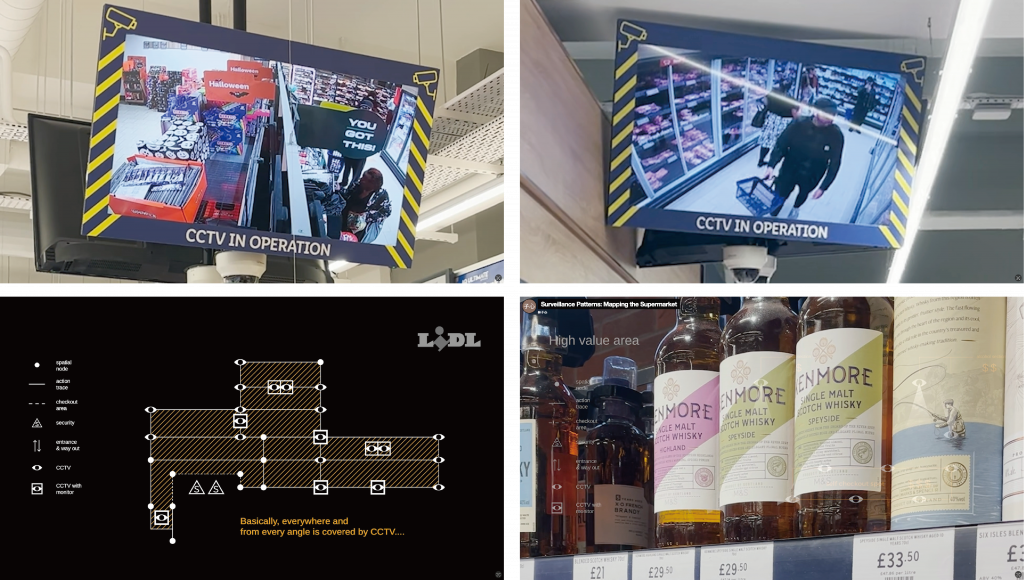
    The video stills of Surveillance Patterns: Mapping the Supermarket.

    During the editing process, I tried to use sound as the foundation, aligning it with images and video so that all the elements work together as one. I also added scenes of food and products as transition shots, giving the film another layer of perspective.
  • Methods of Investigating II (in editing)

    Further developed investigation

    After the tutorial discussion, I decided to focus on supermarkets as my primary research direction.

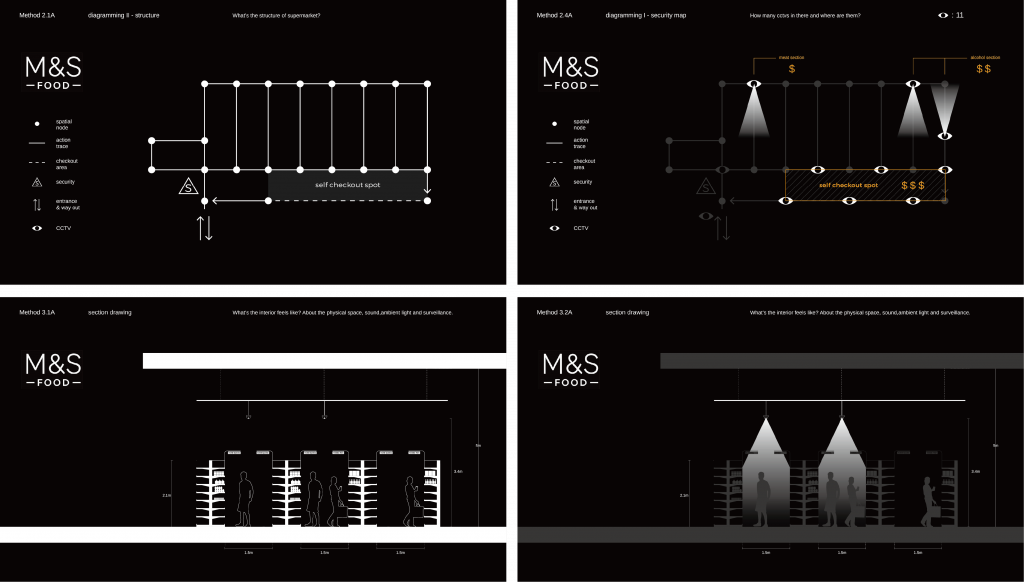
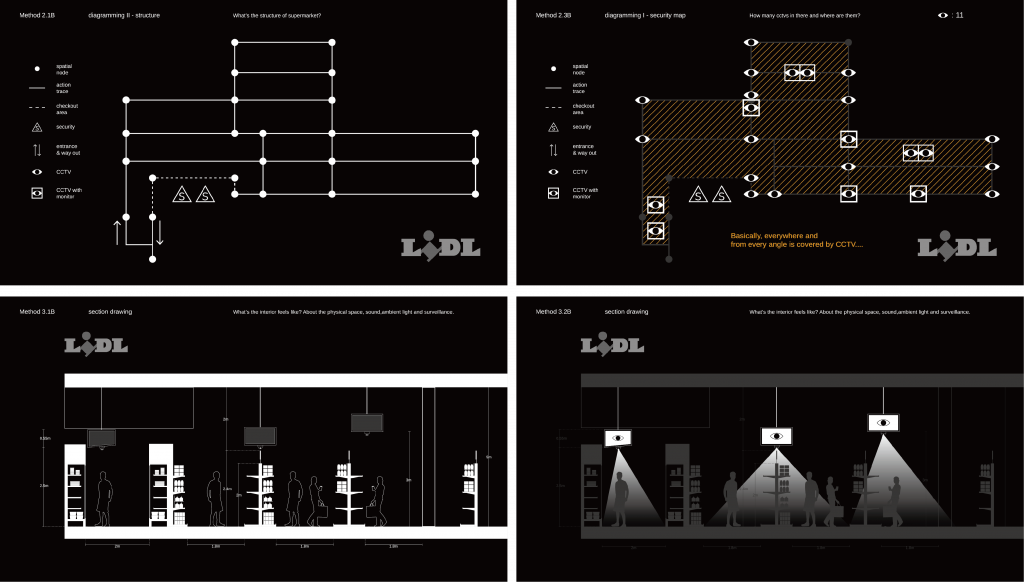
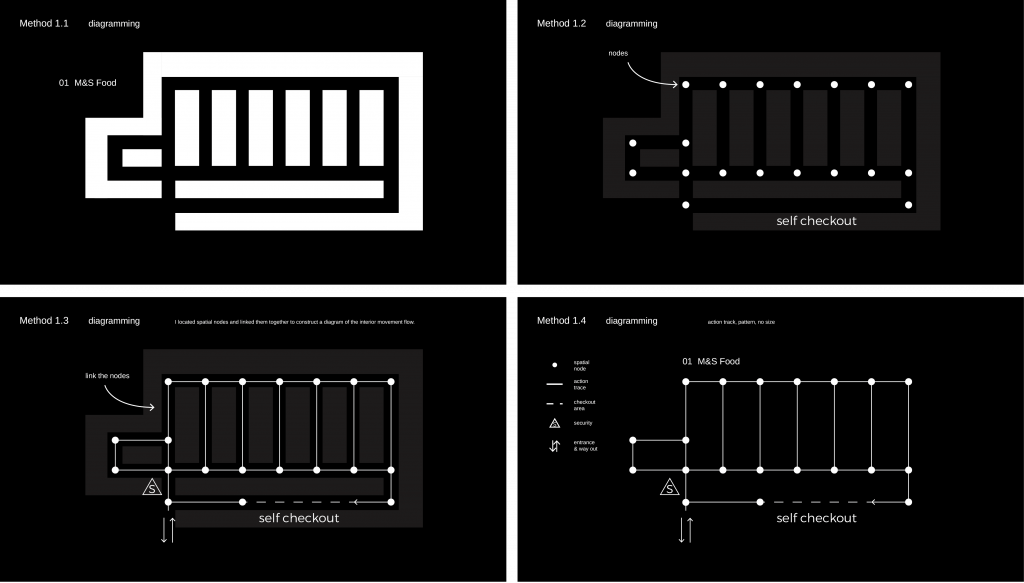
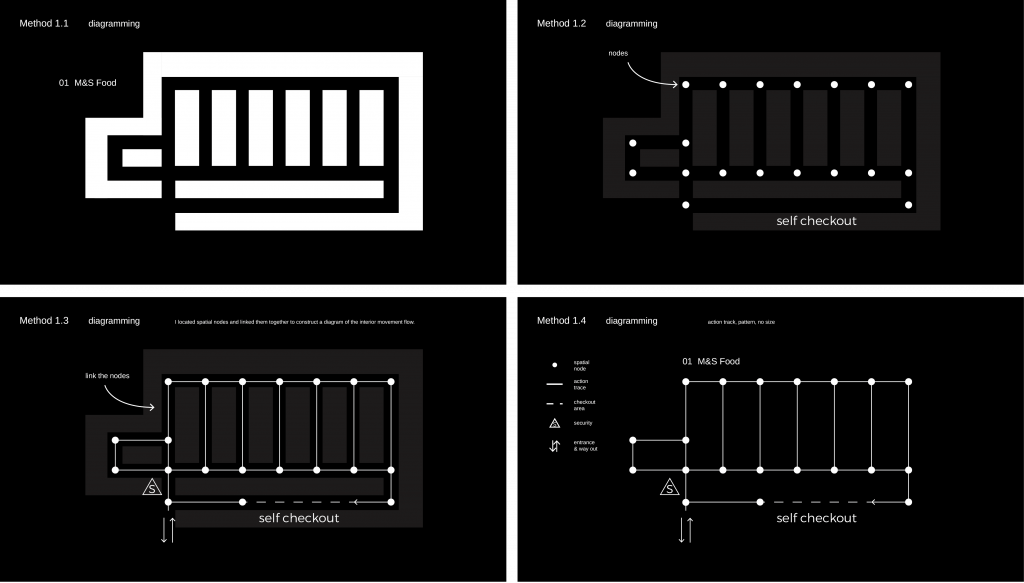
    The mapping process of the supermarket’s spatial network.

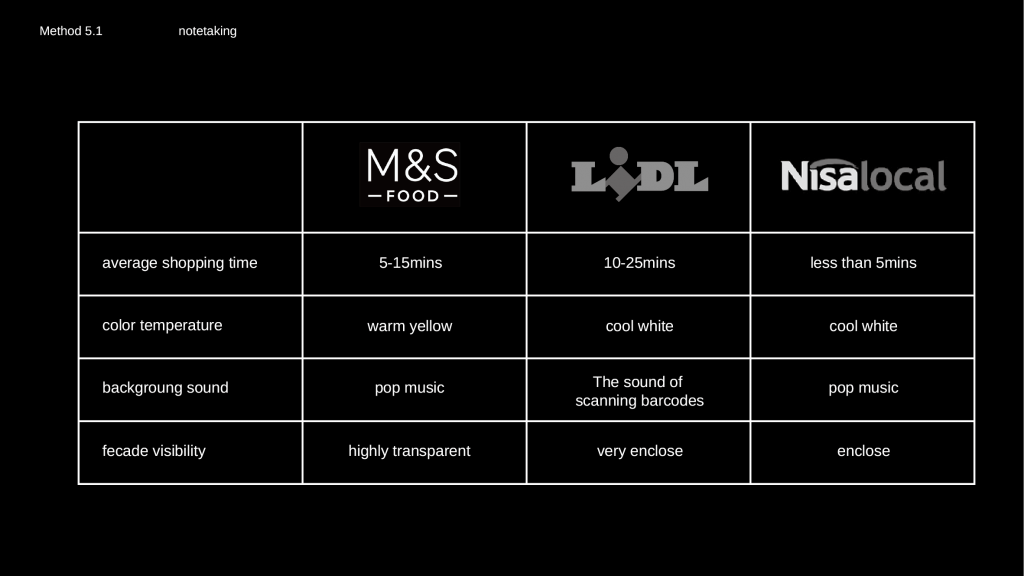
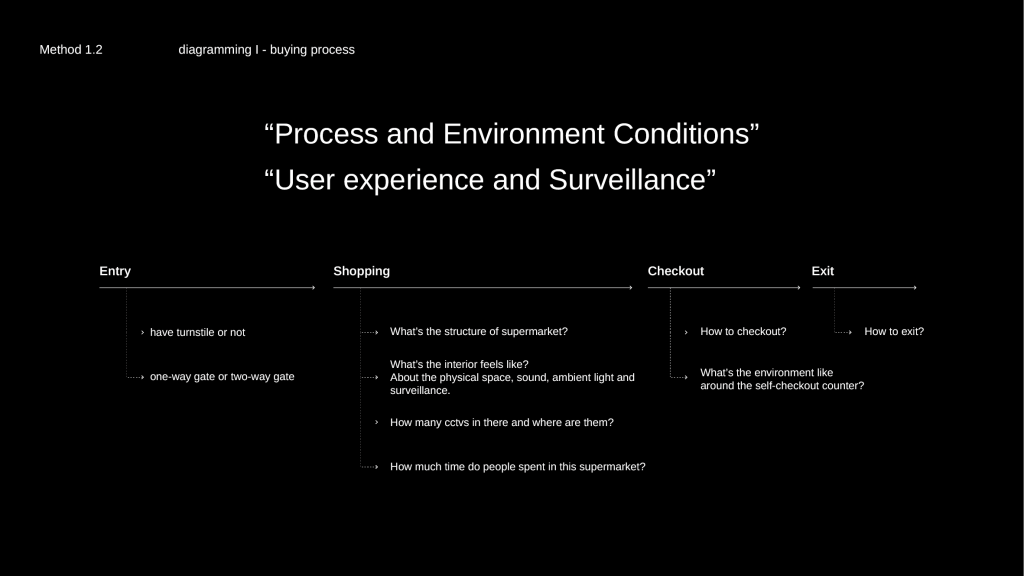
    This week, I began to investigate various aspects of supermarkets, such as their surveillance systems, interior layouts, background sounds, and in-store music. The main aim of this stage is to explore how environmental conditions can intangibly influence customer behaviour.

    Upper: The four stages of buying process with the questions from every stage. Lower: Some environmental conditions in the three different types of supermarket.

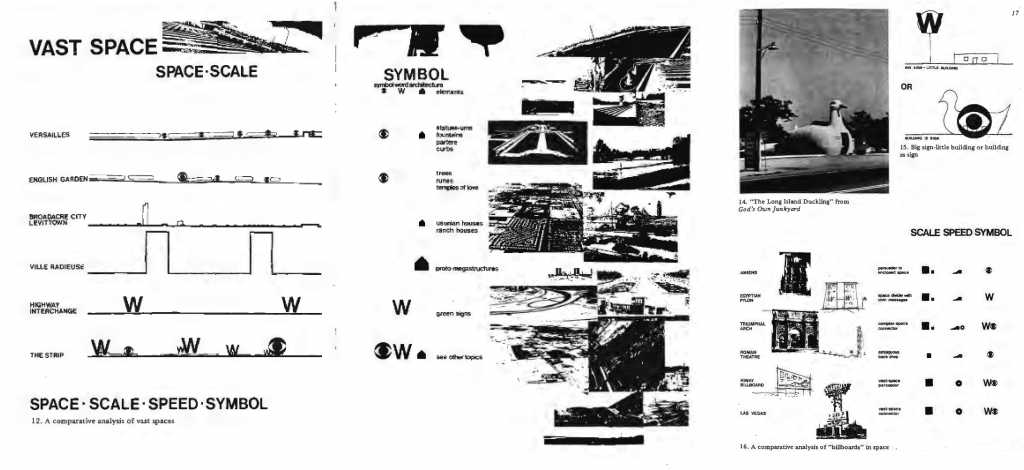
    During this process, I also read Learning from Las Vegas, one of the references from the bibliography. The book discusses how physical environments—such as signboards and architectural styles—emerging from popular culture interact with the spatial context of Las Vegas, creating a distinctive and symbolic urban landscape. In this study, the authors used section drawings and symbols to analyze the relationship between cars and signboards, and this method inspired me to apply similar techniques—using symbols and sectional analysis—to investigate the interior of supermarkets.

    The using of symbols and sections in Learning from Las Vegas.
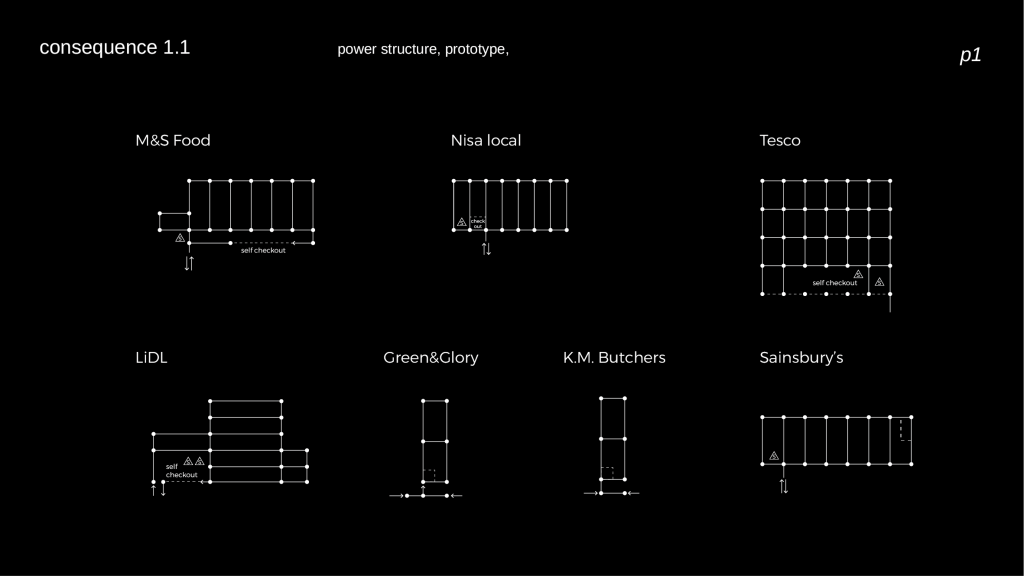
    The spatial network and the section relationship of M&S.
    The spatial network and the section relationship of LiDL.
    The spatial network and the section relationship of Nisa local.

  • Methods of Investigating I

    Site select

    In the beginning, I considered three different site options, all mainly located along Stroud Green Road and in the area near my accommodation in Finsbury Park.
    First, I selected several supermarkets on the street — M&S Foodhall, Nisa Local, Lidl, and Sainsbury’s — as my primary focus.
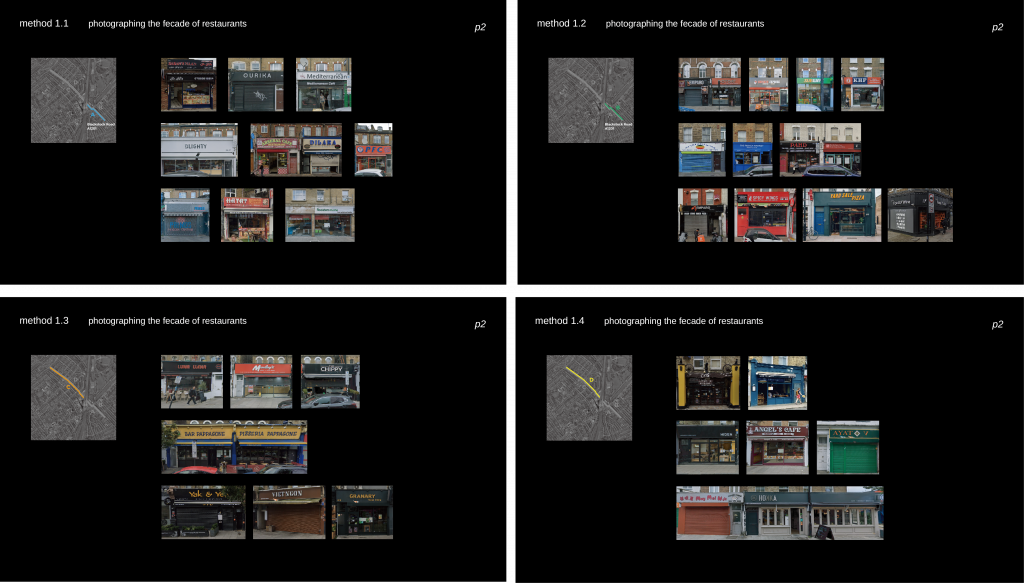
    Second, I noticed that there are many restaurants representing diverse cultural backgrounds, and I chose their signboards as another subject of investigation.
    Finally, I randomly photographed scenes around the Finsbury Park neighborhood to capture its everyday atmosphere.

    Three Methods

    i. Mapping

    I investigated the interior layouts of the selected supermarkets and created maps to represent their spatial structures and circulation networks.

    ii. Cataloging

    Using my phone and Google Maps, I collected images of restaurant signboards and then organized them into a catalog for further analysis.

    iii. Photographing

    I searched for visual similarities between places in London and my home city, Taipei. By walking around the streets and photographing familiar scenes or objects, I attempted to explore the connection between the two environments.